Tiny Wins, Big Shifts: The Science of Momentum in Entrepreneurship
Dec 25, 2025
Why You Feel Stuck Even When You’re Making the Effort
It’s easy for new entrepreneurs to assume they’re stuck because they lack motivation.
Or confidence. Or discipline.
But that’s not what’s actually happening.
What’s happening 99% of the time is there’s a gap between the decision to do something and actually doing it.
You think about what needs to be done, and you decide you’re going to do it. But despite your best intentions, you don’t quite do it. And when your action is missing, many things happen:
Energy leaks. Confidence erodes. Self-criticism happens. People doubt you.
Momentum doesn’t form.
That’s where stagnation (lack of progression) comes from. In this case, you’re not stagnating from fear of doing the thing, but from the fact that you’re not doing it.
And here’s the part that’s commonly misunderstood:
Momentum is not hype, fleeting excitement, or big flashy events. Momentum is a biological system that only activates after motion begins.
My Discovery of Momentum
There was a time in my life when my days ran on autopilot. I maintained the same basic weekly routine, which was familiar and comfortable. I prioritized that routine, and it didn’t leave room for tackling certain projects I knew I had to do.
In my mind, I fully intended to work on those projects. But they never got started. I was putting them off and pouring my energy into the familiar tasks instead.
Every time I was reminded of those projects, I had the unsettling feeling like there was something wrong with me.
I had been attending conferences, workshops and webinars on a regular basis, and one webinar resonated deeply. It was about taking tiny steps forward. I had heard that message before—but this time, the message landed differently. It was what I needed.
This is where I decided to take action. Instead of doing the usual, I cleared my mind and chose one single task. Just one.
I completed it, and it didn’t take long.
Then I chose another, and I completed that one.
Then another.
Before I realized it, I had gotten through a project I’d been avoiding for a while.
The shift wasn’t just practical—it was physical, emotional, and mental.
I gained a ton of energy, and my confidence rose.
Something important locked in:
The reason I had been stuck wasn’t because I couldn’t do difficult things. I was stuck because I hadn’t shown my nervous system that forward movement was safe.
That tiny chain of actions changed how I approach every project I touch today.
Momentum Is a Neuro-Emotional System

Here are things momentum isn’t:
Momentum isn’t motivation, and it isn’t mood.
It’s not inspiration, and it’s not confidence either.
Momentum is what happens when your brain and nervous system receive evidence that it’s safe to move forward.
Here’s how the loop works:
- You make a small decision
- You take a small action
- Your nervous system registers success
- Dopamine is released
- Your brain updates its internal model: “Forward is safe.”
- Repeat
Now the next loop requires less emotional energy than the last.
That’s why momentum feels like it “builds itself.”
Because biologically—it does.
Why Tiny Wins Rewire Identity
Tiny wins can do a lot for productivity. Just try it and see for yourself.
But tiny wins are so much more than that.
Tiny wins are identity anchors.
Every time you follow a decision with action, you send proof to your brain:
- “I am someone who moves.”
- “I am someone who follows through.”
- “I am someone who builds.”
That identity shift happens after motion—not before it.
And that’s the part most motivational advice gets backwards.
If you wait to feel like a builder before you build, you might wait a very long time.
The key is to start building first.
Momentum isn’t powered by the identity you imagine. It’s powered by motion that teaches your brain who you’re becoming.
If this idea resonates with you, you may also appreciate my recent article on why “starting before you’re ready” isn’t the whole story, and why the internal foundation matters just as much.
Where Most People Actually Get Stuck

When entrepreneurs are stuck, most of the time it isn’t because they’re unfit to take action.
They’re stuck because they don’t know which action to take first.
Random small tasks — cleaning a drawer, replying to a simple email, organizing a desktop — often get done. Those aren’t usually the problem. They require no emotional commitment and very little decision-making. They give a brief sense of progress, but not momentum.
The real friction shows up when you face:
- a project that feels big
- a project that has importance
- a project without clear steps
- a project tied to your identity
- a project you don’t want to “mess up”
When a project feels too large or vague, your nervous system simply labels it as unsafe — not in a dramatic way, but in a “let’s not start this today” kind of way.
And so you don’t start.
And the project starts feeling heavy.
Not because the project grew — but because the inertia did.
What Momentum Looks Like When It's Applied to a Real Project
Imagine choosing a project you’ve been avoiding:
- building your website
- creating a business plan
- writing content
- planning your launch
- preparing your financials
Your nervous system will resist if the whole thing feels like too much.
But it responds beautifully to something very small and very clear.
Here’s what momentum actually looks like in practice:
1. You decide on the first tiny step — truly tiny.
Not “write the business plan.”
Something like:
- “Open the document.”
- “List three sections.”
- “Write the first sentence.”
2. You complete that tiny step.
3. Your brain registers that nothing bad happened.
In fact, something good happened: completion of a step.
4. The second tiny step becomes easier to see — and easier to do.
This is exactly what happened in my story.
The project didn’t magically shrink.
My nervous system simply received proof that I was safe to move forward.
Once that proof appeared, the barriers dropped.
How to Apply This to Your Own Work
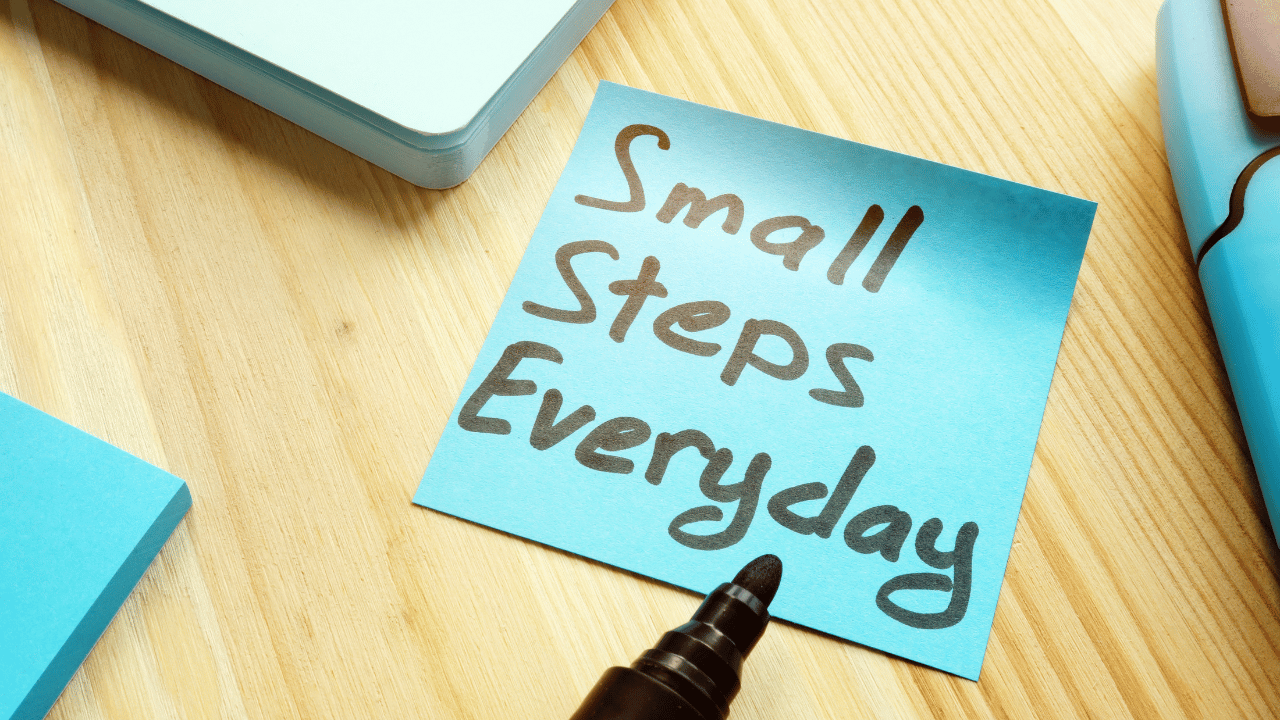
If you’re currently struggling with a project — circling it, avoiding it, questioning yourself about it — here’s a simple way to begin shifting the energy.
1. Pick one project you’ve been avoiding.
Not all of them. Just one.
2. Ask this question:
“What is the tiniest, safest first step in this project?”
It must be:
- small enough to not trigger resistance
- concrete enough to complete
- simple enough that you can start immediately
3. Set the timer for 3 minutes, and do that one step.
Stop when the timer’s done or when you’ve finished the step, if you want.
Overachieving isn’t the goal.
Closing the loop is.
4. Plan your next step in the project.
Notice how the second step becomes clearer.
Your brain now has a direction, and your nervous system has evidence.
Your identity shifts one notch forward.
This is momentum — not hype, not adrenaline, not pushing yourself into exhaustion. Just forward motion.
And it’s calm, grounded, and repeatable.
A Final Thought
If you’ve been feeling stuck, overwhelmed, or strangely tired around certain projects, it doesn’t mean you’re unmotivated or lacking discipline. It simply means the project feels too big, too unclear, or too unsafe for your nervous system to initiate.
Even if you’re figuring everything out before starting, it doesn’t mean momentum will magically appear when it’s needed.
Momentum appears when you take the smallest possible step that signals:
“I can begin.”
One tiny step unlocks the next.
One tiny win rewires the brain.
And one small action can change the entire way you move through your work — and your business.
Where You Go From Here

Momentum isn’t about being brave, being ready, or feeling inspired on command.
It’s about reclaiming control of your wins one tiny, deliberate step at a time.
And when you do that — when you make progress feel safe — something else shifts too:
- You stop viewing your tasks and projects as looming responsibilities.
- You start seeing them as doable paths.
- You begin trusting yourself again.
- You begin becoming the entrepreneur you set out to be.
Momentum isn’t created by massive breakthroughs.
It’s created by closing the action loop — one small movement at a time.
And once you’ve experienced this for yourself, you’ve improved your entire relationship with momentum.
If this article helped you understand why momentum has been so difficult to build — and why tiny steps work far better than pressure or perfection — then you’re already on your way to transforming how you move through your entrepreneurial journey.
Inside Module 1: Entrepreneurial Fitness of our training program, we take this even further.
You’ll learn how to:
- build confidence through micro-actions
- break down overwhelming projects into safe, doable steps
- create a nervous-system-friendly approach to productivity
- develop an identity that supports long-term growth
If you’re ready to feel clearer, more grounded, and genuinely capable of moving your business forward — one step at a time — then Module 1 is your next tiny step.
👉 Learn more about Entrepreneurial Fitness and how it can help you build real momentum.
