
When Success Teaches You the Wrong Lesson
Oct 08, 2026
Some of the most dangerous decisions in business are the ones that actually work.
They usually don't feel dangerous at the time. Quite the opposite. When things turn out well, it is natural to assume the decision that led us there must have been a good one.
But every once in a while, a good outcome can hide a decision that deserved much more scrutiny.
Take the example of an entrepreneur who decides it is time to hire her first employee.
Business has been busy, she is working too many hours, and having another person on her team would certainly make life easier.
At the same time, the increase in work has not been consistent for very long, and her cash reserves are smaller than she would like.
She has some hesitation, but she hires anyway.
A short time later, a prospect she has been talking to for months signs a large ongoing contract.
Suddenly, there is plenty of work for the new employee.
Revenue increases, the pressure begins to ease, and what had felt like a risky decision starts looking like a very good one.
From the entrepreneur's point of view, the outcome seems to confirm that she made the right call.
But did she?
The new contract did not make the original decision any more thoughtful. It simply meant that circumstances happened to work in her favour.
Had the contract never materialized, she might have been forced to look more closely at whether she hired too soon, relied too heavily on business she had merely hoped for, or committed to a regular expense before the business was really ready.
Instead, success may teach her the wrong lesson.
When Success Protects a Bad Decision

A bad decision that succeeds can be harder to learn from than a bad decision that fails.
Imagine if the entrepreneur had run out of funds and couldn't pay her employee. Her financial situation would have forced her to look back at the decision more closely.
But that's not what happened.
She may have walked away believing she had good instincts and had been right to take the risk. Success can make us feel justified in our decision, even when there were good reasons to question it.
Sometimes success is pure luck.
The danger may not show up until the next decision, when you approach it with more confidence because the previous one worked.
I trusted my instincts before, so I can trust them again.
Maybe you can.
Or maybe the circumstances that protected you the first time won't be there again.
If you never stopped to understand why the first decision worked, you may have no idea why the next one doesn't.
When Good Judgment Meets Bad Circumstances

The opposite can happen too.
A careful, reasonable decision can still end with a disappointing result. Things don't always go according to plan. Sometimes you have sheer bad luck or terrible timing.
When that happens, an entrepreneur can quickly start judging themselves.
I should have seen this coming.
I could have done something to prevent this.
The mental anguish can be very real, especially when the outcome results in a financial loss or other hardship.
Those feelings are understandable. But the conclusions we draw from them are not always helpful.
The only information we can work with is what is reasonably available to us at the time we make the decision. That uncertainty is also why it is so important not to keep reopening a decision simply because the outcome disappoints us.
Technically, we might have been able to predict a problem if we had known exactly what to look for.
But that is very different from having a reasonable reason to look for it in the first place.
So was it actually bad judgment?
Or was it a reasonable decision paired with bad circumstances?
One useful question is:
If I could go back to the day I made the decision, knowing only what I knew then, would I make a different choice?
If the answer is yes, there may have been something you could reasonably have done differently.
Maybe you overlooked a warning sign, relied too heavily on an assumption, or failed to gather information that was reasonably available.
If the answer is no, the bad outcome may not mean the decision itself was poor.
You can still learn something useful from a setback without pretending you should have known it all along.
What Did the Decision Actually Teach You?

This is the distinction that can easily get lost. Researchers call it outcome bias: the tendency to judge the quality of a decision partly by how it turned out.
A good result does not automatically prove that you made a good decision.
A bad result does not automatically prove that you made a bad one.
Sometimes the decision and the outcome line up perfectly.
Sometimes they don't.
The point is to understand why they didn’t. A few questions can help:
- What did you reasonably know when you made the decision?
- What assumptions were you making?
- Was there something important you ignored?
- What happened afterward that was outside your control?
That is where the useful lesson usually sits.
Because experience does not automatically make us better decision-makers.
It only helps when we understand what it was actually teaching us.
Put It Into Practice
Think of one business decision that surprised you with how well—or how badly—it turned out.
Instead of reviewing only the result, go back to the moment before you knew what would happen next.
What did you know, what did you assume, and what part of the eventual outcome had nothing to do with the quality of the decision itself?
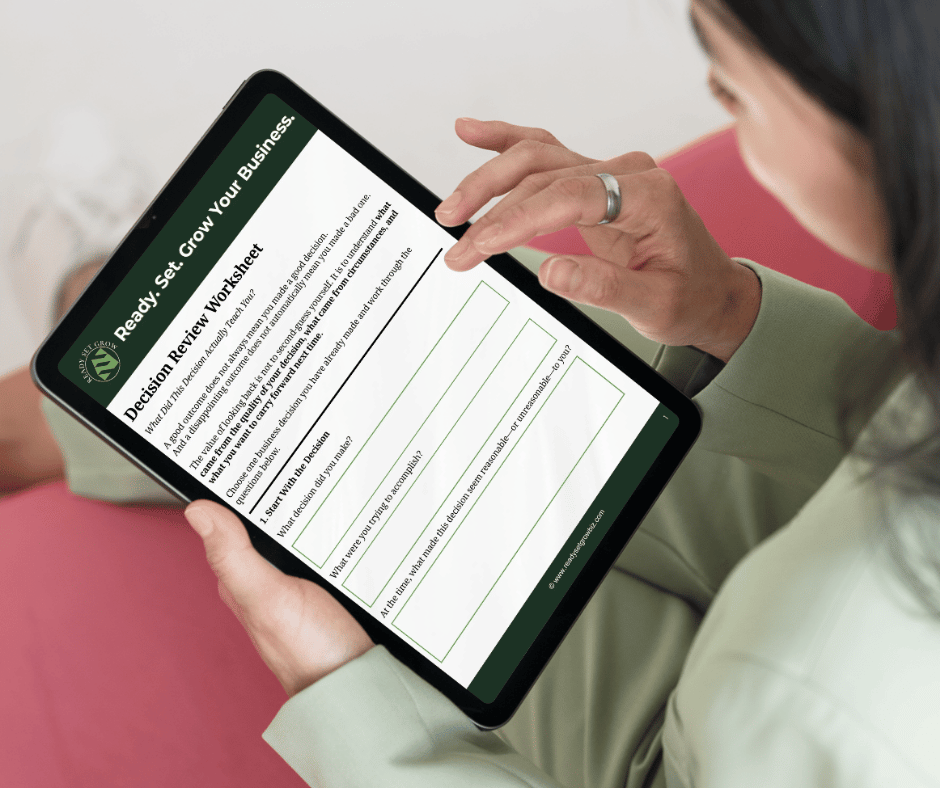
To make this process easier, I prepared a worksheet for you.
Download the Decision Review Worksheet today by filling in the form and use it to separate what you could reasonably control from what you only learned afterward. You'll also explore every resource inside our free library.
 The goal isn't to rewrite the past.
It's to make sure you carry the right lesson into your next decision.
