Why Future Clients Notice More Than Your Marketing
Sep 17, 2026
Your homepage says your service is simple and personal.
A prospective client reads that promise.
Then they open three of your products and services pages and become confused about what you actually offer. The contact form asks questions that don’t even seem relevant to them.
We experience this kind of frustration online all the time. We’ve become so used to it that it may not seem like a big deal. We simply click away.
But…
Your homepage makes a promise, and the rest of your website contradicts that promise.
Future clients don’t evaluate a business only through what a website or LinkedIn profile tells them. They also notice what their experience is like.
The question is not whether every detail is perfect.
It is whether what they experience is consistent with what your marketing led them to expect.
Every Marketing Claim Creates an Expectation

A service page describes your approach as “straightforward.” → The reader now expects the next step to be reasonably easy to understand.
Your website says you provide “personalized guidance.”→ The reader expects your communication to feel attentive to their situation.
Marketing language does more than explain what you offer. It teaches people what to expect.
Words such as responsive, professional, simple, thoughtful, and transparent therefore create standards against which the rest of the business might be interpreted.
Edelman’s 2025 Brand Trust research, based on 15,000 respondents across 15 countries, reinforces the broader point: Trust is not established by statements alone. It depends on how a brand actually shows up in practice.
For a new entrepreneur, that distinction matters. Credibility becomes easier to build when your marketing describes something people can actually experience.
Prospects Notice What Happens Beyond the Marketing
Let’s say a potential client reads your informative article and then clicks through to your website that has outdated links.
Another sees “we make the process easy” on the homepage, then encounters a confusing booking process.
Someone else sees “we listen closely” in your marketing, but then receives a response from your service team that doesn’t address the question they asked.
These are not necessarily major failures. They are indicators.
Before working with you, prospects cannot know how clear your advice will be, how organized the process will feel, or whether the experience will match what was promised. So they make judgments based on the information available to them.
Your marketing is one source of information.
Your website structure, forms, public communication, FAQ’s, emails, and conversations are others.
The important part is that people compare what they actually experience with the marketing.
Contradictions Matter More Than Imperfection

A small typo appears on an otherwise useful webpage → Most reasonable people understand that mistakes happen.
But they might react differently when a business proudly promotes “exceptional attention to detail” while its online materials are outdated and instructions contradict one another.
The true issue is the discrepancy between the promise and the evidence.
That can be reassuring if you already worry about appearing professional enough. The good news is that building trust with clients does not require an immaculate website or a perfectly polished public presence.
But alignment is critical.
If you promise simplicity → unnecessary confusion must be cleared up.
If you promise personal attention → you must examine whether your communication feels personal.
If you promise transparency → you must ensure you are upfront with the important information.
Brand Consistency Is About More Than Colours and Fonts
Traditional brand consistency often focuses on visual identity and messaging. Those things do count, and yet service businesses also need another kind of consistency:
Expectation consistency.
Does the same basic promise survive from one interaction to the next?
Let’s say a prospect finds you through LinkedIn, visits your website, reads an article, and eventually sends an inquiry.
Technically, these are separate interactions.
But to the prospect, they form one overall experience of your business, and inconsistencies between them can stand out.
A warm brand voice followed by a cold process creates friction. A promise of simplicity followed by unnecessary complexity does the same.
Each of these can make the prospect wonder which version of the business is the real one, and some prospects can instantly lose trust.
Make Your Marketing Easier to Believe

If your values are listed on your About page, many prospects could read them.
Your prospects could also experience those values being carried out throughout their interactions with you, for example, during your contact process, in your service pages, emails, conversations, and in your decisions.
Not only can these experiences be positive for your prospects, but also for you as a new entrepreneur. Here’s why:
When the experience supports the promises in your marketing, you have less reason to manage every impression or compensate for being new with increasingly impressive claims. The business itself begins supporting what you say about it.
You do this by narrowing the gap between promise and reality.
One useful place to start is by comparing a few of the promises your marketing makes with what a prospective client is actually likely to experience.
Our free Marketing Promise Alignment Check will walk you through that process. It will help you identify three promises your marketing currently makes, examine where those promises show up in the prospect experience, and uncover any gaps that may be worth strengthening.
This is not about polishing your image.
It is about strengthening your business foundations so the prospect’s experience reinforces the credibility your marketing is trying to establish.
Your marketing tells people what to expect.
Everything else they encounter helps them decide whether to believe it.
For a related perspective on how the business is shaped by the founder, read my article, The Founder Identity Audit: The 10 Questions Every New Entrepreneur Should Ask.
If you are building your business from the ground up, Ready Set Grow’s free guide, Shaping Your Startup for Success, can help you think through the early decisions that shape how people experience your business.
Get Shaping Your Startup for Success
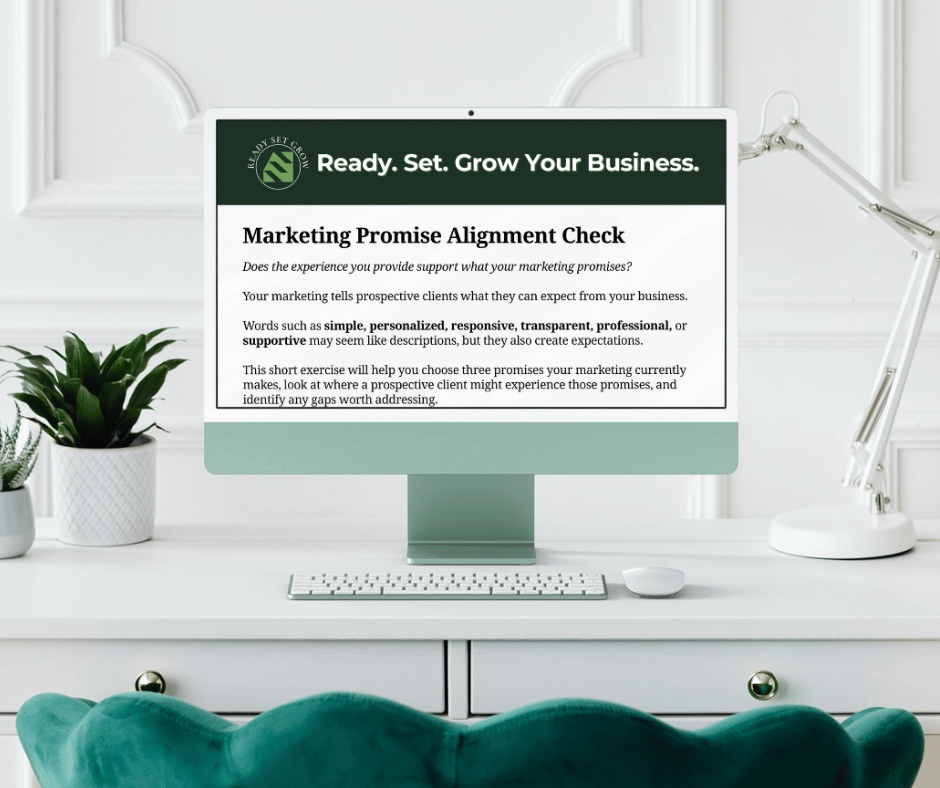 Grab the Marketing Promise Alignment Check on our Free Resources Page by signing up below.
